

Most businesses invest in a logo and call it a brand. The organizations that command real market authority do something different: they build a brand architecture — a deliberate structure that connects who they are, what they promise, and how every touchpoint reinforces that promise. This is the difference between being recognized and being trusted.
Visual Identity Is the Surface, Not the System
A visual identity — your logo, palette, and typography — is the most visible layer of a brand, but it is only the surface. When a company treats design as the whole of its brand, it ends up with a beautiful shell and no structural integrity underneath. Customers sense the gap immediately: the website looks polished, but the sales conversation, the onboarding, and the follow-through tell a different, disconnected story.
Brand architecture is the system beneath the surface. It defines the relationship between your master brand, your sub-brands, your products, and — critically for founders — your personal brand. It answers questions like: Does your consulting practice trade on your name, your company’s name, or both? When you launch a new offer, does it inherit the authority of the parent brand or start from zero?
The Three Models of Brand Architecture
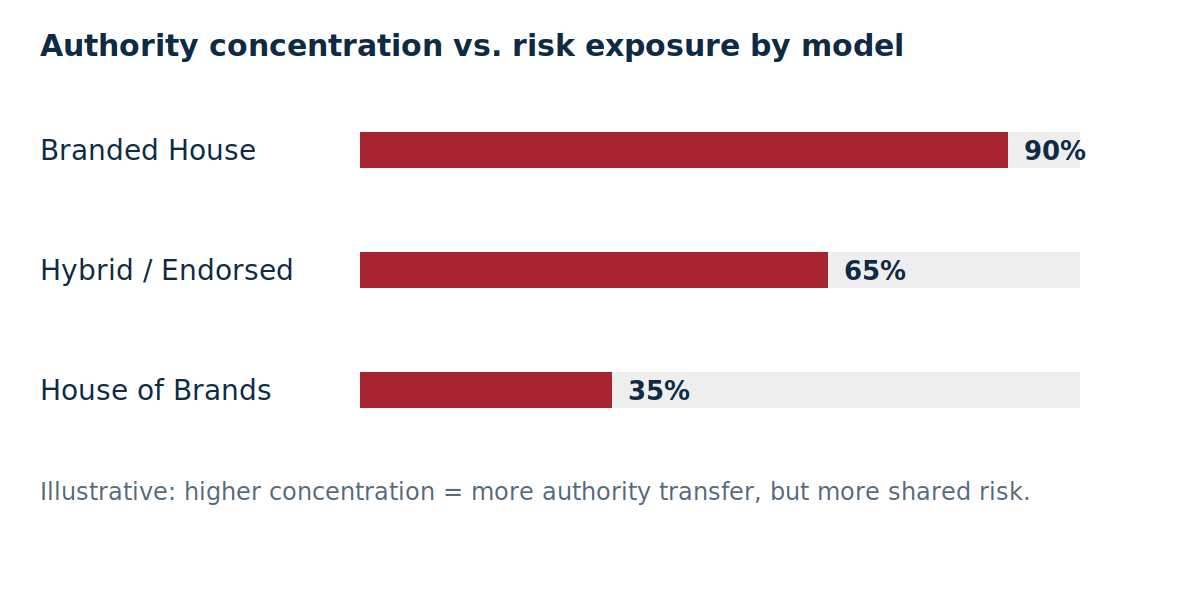
Strategists generally recognize three structural approaches, popularized in part by brand consultancy frameworks such as those documented by Interbrand and the work of David Aaker on brand portfolio strategy:
- Branded House: One master brand covers everything (think Google, or FedEx). Every offer reinforces a single name. This concentrates authority but risks diluting it if quality varies.
- House of Brands: A parent owns distinct, independent brands (think Procter & Gamble). Each brand stands alone, insulating the others from risk — at the cost of higher marketing spend per brand.
- Hybrid / Endorsed: Sub-brands carry their own identity but are endorsed by the parent (think “Marriott” endorsing “Courtyard”). For most founders and consultants, a hybrid model — where your personal name endorses your company’s offers — is the most capital-efficient path to authority.
From Identity to Authority: The Four Layers
Moving from a visual identity to genuine market authority means building four connected layers, each supporting the one above it:
- Layer 1 — Foundation (Purpose & Positioning): Why you exist and the specific position you own in the buyer’s mind. Without this, everything above is decoration.
- Layer 2 — Verbal Identity (Messaging & Voice): The language that makes your positioning repeatable. If your team can’t articulate the promise in one sentence, neither can your customers.
- Layer 3 — Visual Identity (Design System): The logo, palette, and system that make the brand instantly recognizable and consistent across every surface.
- Layer 4 — Experience (Delivery & Proof): The lived reality of working with you. Authority is ultimately earned here — through results, testimonials, and consistency over time.
Notice that visual identity — the layer most businesses start and stop with — sits third. It amplifies a strong foundation and undermines a weak one. A striking logo on a brand with no clear positioning simply makes the confusion more memorable.
Why Authority Compounds
The strategic payoff of brand architecture is compounding. Research into brand equity consistently shows that established, trusted brands command price premiums and reduce customer acquisition friction — buyers extend trust to new offers based on prior experience. When your architecture is coherent, every new product, article, or speaking engagement deposits into the same account. When it’s fragmented, each effort starts from zero.
For a founder building a personal-plus-corporate brand, this is the entire game. Your name earns authority through visible expertise; your company converts that authority into scalable offers. Structured well, the two reinforce each other. Structured poorly, they compete.
A logo makes you recognizable. An architecture makes you inevitable — the obvious choice before the conversation even starts.
Your First Move
Before redesigning anything visual, map your current architecture honestly. Write down every brand, sub-brand, product, and the role your personal name plays. Ask whether a stranger could understand how they connect in thirty seconds. If not, the problem isn’t your logo — it’s the structure. Fix the architecture first, and the visual identity finally has something worth expressing.
Sources & Further Reading
- David A. Aaker, Brand Portfolio Strategy (Free Press) — foundational framework on branded house vs. house of brands.
- Interbrand, “Best Global Brands” methodology — on brand strength and authority measurement (interbrand.com).
- Harvard Business Review, ongoing coverage of brand equity and pricing power (hbr.org).