
Before a boardroom partner, an investor, or a high-ticket client ever meets you, they Google you. What they find in those first ninety seconds decides whether the relationship starts on a foundation of credibility — or skepticism you’ll spend the whole conversation overcoming. Your executive digital footprint is doing this work every day, whether you’ve designed it or not.
The Footprint You Have vs. the One You Designed
Every executive already has a digital footprint. The only question is whether it was built deliberately or by default. A default footprint is a scattering of outdated profiles, a neglected LinkedIn, and whatever search happens to surface. A designed footprint is a coherent, intentional presence that tells a consistent story of authority the moment someone looks.
For senior professionals, the stakes are high. Decision-makers use online presence as a proxy for competence and seriousness. An executive with a sharp, substantive digital footprint signals that they’re a current, credible operator. One with a stale or absent presence raises quiet doubts — not because the person lacks ability, but because the signal is missing.
The Four Pillars of an Executive Footprint
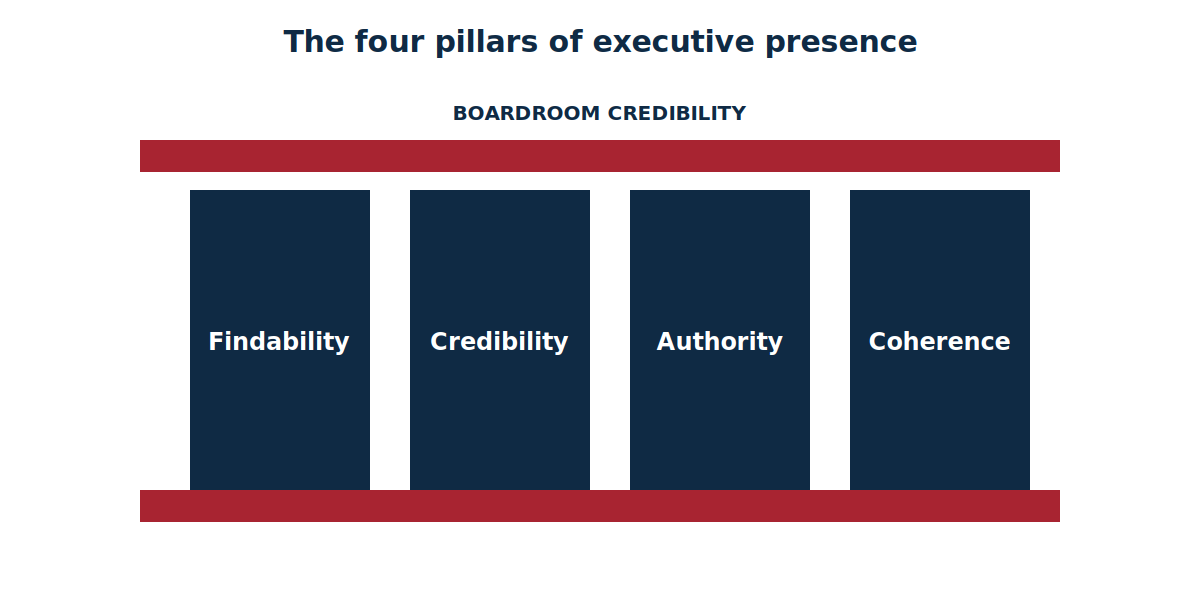
A boardroom-grade digital presence rests on four pillars, each answering a question the observer is silently asking:
- Findability — “Can I even find them?” A professional presence on the platforms your audience uses, and control over what appears when your name is searched.
- Credibility — “Are they legitimate?” Consistent titles, verifiable accomplishments, credentials, awards, and third-party validation across profiles.
- Authority — “Do they actually know their field?” Substantive content — articles, talks, commentary — that demonstrates expertise rather than merely claiming it.
- Coherence — “Do the pieces add up?” A single, consistent narrative across every touchpoint, so the LinkedIn, the website, and the bio all tell the same story.
LinkedIn: The Executive Home Base
For B2B and boardroom audiences, LinkedIn is the single highest-leverage platform — it’s where decision-makers already are and where they expect to vet you. A framework for an authority-grade profile:
- The headline is positioning, not a job title. “CEO, NessLek 360°” is a label. “Helping founders turn expertise into scalable ventures” is a position. Use the space to state the value you create.
- The “About” section tells a narrative. Not a résumé in paragraph form — a story of what you do, for whom, and why it matters, written in your voice.
- Featured proof. Pin your strongest assets: an award, a flagship article, a case study. Make the evidence impossible to miss.
- Consistent, substantive posting. You don’t need to post daily. You need to post things worth reading, consistently enough that a visitor sees an active, thinking operator.
Your digital footprint is the only part of your reputation that works 24 hours a day, in every timezone, whether you’re in the room or not. Under-investing in it is under-investing in every future opportunity.
Content as the Authority Engine
The difference between a credible profile and an authoritative one is content. Claiming expertise is weak; demonstrating it is undeniable. This doesn’t require volume — it requires substance. A handful of genuinely insightful articles, a recorded talk, thoughtful commentary on your industry’s real problems — these compound into a body of work that makes your authority self-evident. This is precisely why a well-built content library (like the one this article belongs to) is a strategic asset, not a marketing afterthought.
Auditing Your Own Footprint
- Search yourself. Open an incognito window and Google your name. The first page is your de facto business card. Is it the one you’d choose?
- Check consistency. Do your title, positioning, and key facts match across LinkedIn, your website, and your bios? Inconsistency reads as carelessness.
- Assess your proof. Is your strongest evidence — awards, results, credentials — visible within seconds, or buried?
- Evaluate recency. When did you last publish something substantive? A presence frozen in the past signals a career frozen in the past.
The Bottom Line
An executive digital footprint that attracts boardroom partners isn’t built by accident or by vanity posting. It’s engineered — findable, credible, authoritative, and coherent — so that the ninety-second search that precedes every important relationship works in your favor. Design it deliberately, and it becomes the quiet asset that opens doors before you’ve said a word.
Sources & Further Reading
- LinkedIn, official research and guides on executive presence and profile best practices (linkedin.com).
- Edelman Trust Barometer — on credibility and trust in business leaders (edelman.com).
- Harvard Business Review on personal branding for leaders (hbr.org).