
A pitch deck sells a story. A high-ticket consulting offer sells a transformation — with the risk, the roadmap, and the return made explicit enough that a serious buyer can say yes without a leap of faith. If your proposals still lead with your process instead of the client’s outcome, you’re leaving most of your fee on the table.
Why “Beyond the Pitch Deck” Matters
Pitch decks are built to generate interest. High-ticket offers are built to close committed, five- and six-figure engagements. The two require different structures. A deck can get away with being aspirational; an offer has to survive procurement, a skeptical CFO, and the buyer’s internal question — “what exactly am I paying for, and what happens if it doesn’t work?”
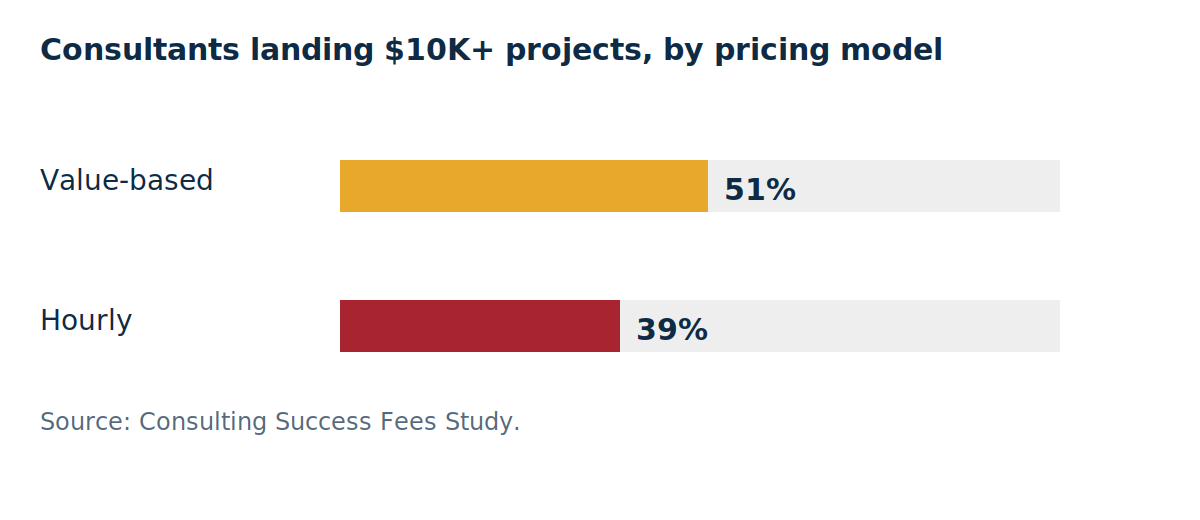
The economics reward getting this right. Industry research on consulting fees found that consultants using value-based pricing are markedly more likely to land larger projects — roughly 51% of value-based consultants win projects worth $10,000 or more, versus 39% of those billing hourly (Consulting Success Fees Study). The offer structure, not just the delivery, is what unlocks the higher tier.
The Anatomy of a High-Ticket Offer
A structured high-ticket offer has seven components. Miss any of them and the buyer fills the gap with doubt:
- The Outcome: The specific, quantified result the engagement delivers. Not “improved marketing” but “a repeatable pipeline generating X qualified leads per quarter.”
- The Gap: Where the client is now versus where the outcome puts them. This makes the value of closing the gap tangible.
- The Mechanism: Your unique method or framework for getting there. This is what makes you non-comparable to a cheaper alternative.
- The Roadmap: The phased plan, with milestones. It converts an abstract promise into a concrete sequence the buyer can visualize.
- The Proof: Case studies, results, and testimonials that make the outcome believable.
- The Risk Reversal: How you de-risk the decision — a pilot phase, milestone-based payments, or a clear scope guarantee.
- The Investment: The price, framed against the value of the outcome — never against your hours.
Anchor on Value, Not Hours
The single biggest lever is how you frame price. If a project is projected to generate or save the client a large sum, a fee that is a fraction of that number reads as a smart trade — not a cost. As one widely-cited illustration puts it: billing 40 hours at an hourly rate for a website redesign might net a few thousand dollars, but pricing that same redesign at a fraction of the six-figure revenue it’s projected to unlock changes the entire conversation. The hours become irrelevant; the return becomes the point.
Buyers don’t resist high prices. They resist unclear value. Make the return obvious and the fee stops being the objection.
Structuring the Tiers
Serious buyers want a choice — but a guided one. A three-tier structure (often called good-better-best) lets the client self-select while anchoring on your premium option:
- Tier 1 (Entry): A focused, lower-risk engagement — an audit, a strategy sprint — that delivers a clear early win and opens the relationship.
- Tier 2 (Core): The primary transformation offer. Most buyers land here. Price and scope it as your default recommendation.
- Tier 3 (Premium): The comprehensive, done-with-you or done-for-you package with the highest support and certainty. It makes Tier 2 look reasonable and captures buyers who want maximum outcome.
The First Step
Take your current proposal and audit it against the seven components above. Most consultants discover they lead with mechanism and process — how they work — and bury or omit the outcome, the proof, and the risk reversal. Reorder it so the client’s transformation comes first and your method supports it. That single restructuring is often the difference between a declined quote and a signed six-figure engagement.
Sources & Further Reading
- Consulting Success, Consulting Fees Study — data on pricing models and project size (consultingsuccess.com).
- Alan Weiss, Value-Based Fees — the standard reference on pricing consulting by outcome.
- Harvard Business Review, on B2B buying and value communication (hbr.org).