
Forty-three certifications sounds like a résumé flex. It isn’t. Each one was a deliberate bet on staying relevant in a market that rewrites itself every eighteen months. What that portfolio actually taught me has less to do with any single credential and everything to do with a capability most executives never develop: portfolio agility.
The Real Question Isn’t “Is Learning Worth It?”
Every executive agrees continuous learning matters. The harder, more useful question is: what is the return on a given hour of upskilling, and how do you choose where to invest it? Treating professional development as a vague virtue leads to scattered effort — a course here, a webinar there, no compounding. Treating it as a portfolio, with allocation logic, changes everything.
The labor market has made this urgent. The World Economic Forum’s Future of Jobs research has repeatedly found that a large share of workers’ core skills will be disrupted within five years, and that a significant proportion of workers will need reskilling. For leaders, the exposure is even higher — because your decisions ripple across the whole organization.
Portfolio Agility: The Skill Behind the Skills
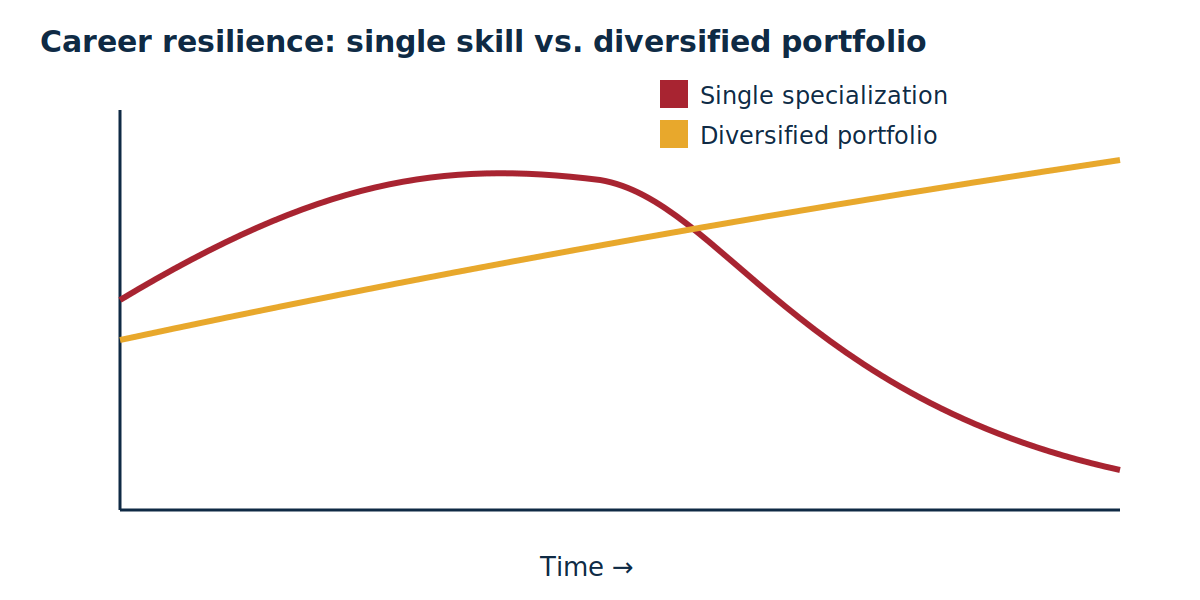
Portfolio agility is the ability to hold a diversified set of competencies and reallocate your learning as the market shifts — the same way a fund manager rebalances assets. It rests on three habits:
- Diversification: Pairing deep expertise (your core) with adjacent capabilities (your hedges). A marketing leader who also understands data, finance, and AI tooling is resilient to shocks in any one area.
- Rebalancing: Periodically dropping skills that are commoditizing and adding ones that are appreciating. This is uncomfortable — it means letting go of things you were once known for.
- Compounding: Choosing new skills that multiply the value of existing ones, rather than isolated novelties.
What 43 Certifications Actually Taught Me
The credentials themselves matter less than the meta-lessons the process delivered:
- Speed of acquisition is a skill you can train. The tenth certification took a fraction of the effort of the first. Learning how to learn — spaced repetition, active recall, immediate application — compounds faster than any single subject.
- Adjacent knowledge creates disproportionate leverage. Understanding just enough about a neighboring discipline lets you lead specialists in it, spot bad work, and connect dots others miss.
- Credentials open doors; applied skill keeps you in the room. A certificate signals commitment and gets the meeting. What you do with the knowledge determines whether there’s a second meeting.
- The market pays for synthesis, not accumulation. The value wasn’t in holding 43 separate skills; it was in the rare combinations they made possible.
A certification is a receipt for a bet on your future relevance. The ROI isn’t the certificate — it’s the option it keeps open.
How to Build Your Own Learning Portfolio
- Define your core. The one or two competencies your reputation rests on. Protect and deepen these.
- Choose deliberate hedges. Two or three adjacent skills that would matter most if your industry shifted. AI literacy is, for nearly every executive right now, a non-negotiable hedge.
- Set an allocation. Decide how many hours per month go to core deepening vs. hedge exploration. Track it like a budget.
- Review quarterly. What’s commoditizing? What’s appreciating? Rebalance without sentimentality.
The Bottom Line
Executive upskilling isn’t about collecting credentials — it’s about maintaining optionality in an economy that punishes rigidity. The leaders who thrive over the next decade won’t be the ones who knew the most in 2025. They’ll be the ones who built the capability to keep re-learning faster than their market changes.
Sources & Further Reading
- World Economic Forum, Future of Jobs Report — on skill disruption and reskilling timelines (weforum.org).
- Barbara Oakley, Learning How to Learn (Coursera / Deep Teaching Solutions) — on accelerating skill acquisition.
- LinkedIn Learning, annual Workplace Learning Report — on L&D trends and executive development (learning.linkedin.com).