
Hourly billing feels safe. You know your rate, you track your time, you send an invoice no one can argue with. But that safety comes with a hidden tax: it caps your income, punishes your efficiency, and quietly tells the market you’re a vendor, not a partner. Value-based pricing flips all three — if you have the positioning to support it.
The Mathematical Ceiling of Hourly Work
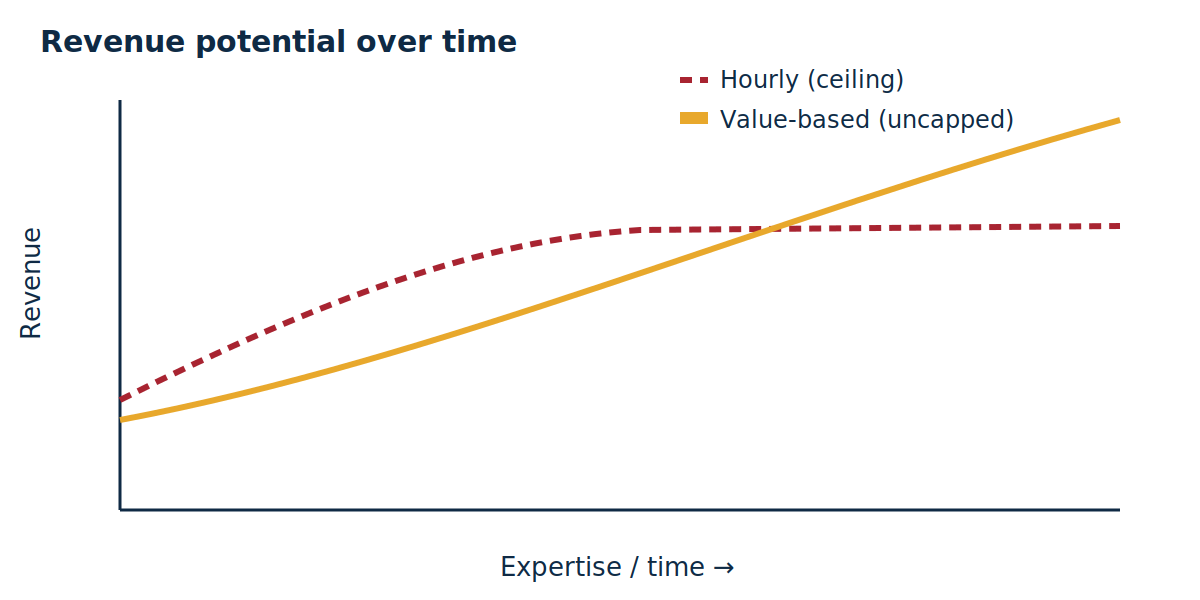
The problem with hourly billing isn’t philosophical — it’s arithmetic. There are a fixed number of billable hours in a week, and no consultant bills all of them. Analyses of independent consulting suggest most bill only 20–25 hours of a 50-hour week; the rest goes to sales, admin, and proposals. At a strong rate, that still imposes a hard annual ceiling you can only raise by hiring or charging more per hour — which just moves the ceiling, never removes it.
Worse, hourly billing penalizes mastery. The consultant who once needed 20 hours for a brand strategy and now needs 9 is, under hourly logic, taking a pay cut for getting better. That’s a broken incentive.
What Value-Based Pricing Actually Does
Value-based pricing ties your fee to the economic outcome you create, not the time you spend. If a project is projected to generate or save a client a large sum, your fee is priced as a fraction of that value. The same expertise, the same work — but the price reflects the return, not the clock.
The data supports the shift. According to the Consulting Success Fees Study, consultants using value-based pricing are significantly more likely to land $10,000+ projects — about 51% versus 39% for hourly billers. Yet adoption remains low: various studies put the share of consultants primarily using value-based pricing at roughly a quarter or less, meaning most of the market is still competing on the least profitable model.
The Honest Prerequisites
Value-based pricing is not a magic switch, and it’s worth being candid: it fails without three foundations in place.
- Measurable ROI. You must be able to connect your work to an outcome the client can quantify — revenue, cost savings, efficiency, risk reduction. If the value is genuinely unmeasurable, value-based pricing is hard to justify.
- Positioning and confidence. The buyer has to see you as a strategic partner, not a task-doer. That perception is earned through authority — proof, reputation, and the way you frame the conversation.
- Supporting assets. Case studies, a documented methodology, and outcome data. These are what let you make the value credible before the work begins.
This is why a hybrid path often works best in practice: bill hourly or fixed-fee for a discovery phase, then switch to value-based fees for execution once the ROI is clear and trust is established. Hourly becomes a bridge while your authority builds — not a permanent home.
How to Have the Value Conversation
The mechanics are simpler than they seem. Instead of quoting a number, you get the client to quantify the stakes first. A reliable opener, used by experienced consultants, is some version of: “What is solving this worth to you and your company?” Once you both agree on what’s at stake — more revenue, lower turnover, saved cost — you have a shared basis for a fee tied to a clear return. You can further reduce the buyer’s risk with tiered options, where the highest tier carries the most support and certainty.
You are not asking the client to pay for your time. You are offering them a return on an investment. Price the return, and the fee justifies itself.
Making the Transition
- Start with your track record. Document the measurable results of past work. This is your evidence you can do it again.
- Pilot on one offer. Convert a single, repeatable service to value-based or fixed pricing first. Learn before you convert everything.
- Anchor high, then tier. Present the premium outcome first; let lower tiers look reasonable by comparison.
- Track your real delivery cost. Even on value or retainer work, log your time privately — not to bill it, but to know your true margins and inform every renewal.
The Bottom Line
Hourly billing is safe but capped. Value-based pricing is powerful but demands authority, clarity, and proof. The most successful consultants don’t charge for time — they charge for transformation. If you want clients to treat you as a partner rather than a vendor, align your fees with the business impact you create, and back it with the positioning that makes the price obvious.
Sources & Further Reading
- Consulting Success, Consulting Fees Study and 54 Consulting Statistics (consultingsuccess.com).
- Alan Weiss, Value-Based Fees — foundational text on outcome pricing.
- Harvard Business Review and the U.S. Small Business Administration on pricing strategy (hbr.org, sba.gov).