
Every consultant eventually hits the same wall: your income is chained to your calendar. You can only sell so many hours, and when you stop working, the revenue stops with you. Productization is how you break the chain — turning the expertise locked inside your head and your service delivery into scalable intellectual property that sells while you sleep.
The Trap of Pure Service
Active service — trading your time and attention for fees — is where nearly every consultant starts, and for good reason: it’s high-margin, low-overhead, and directly monetizes what you know. But it has the same fatal ceiling as hourly billing: it doesn’t scale beyond your personal capacity. Growth means either working more hours (impossible past a point) or hiring more people to sell their hours (a different, harder business).
Productization offers a third path. Instead of delivering your expertise one client at a time, you encode it into an asset — a framework, a course, a template, a tool, a piece of software — that can be sold repeatedly with little or no additional delivery effort. The knowledge that once served one client now serves a hundred.
The Productization Spectrum
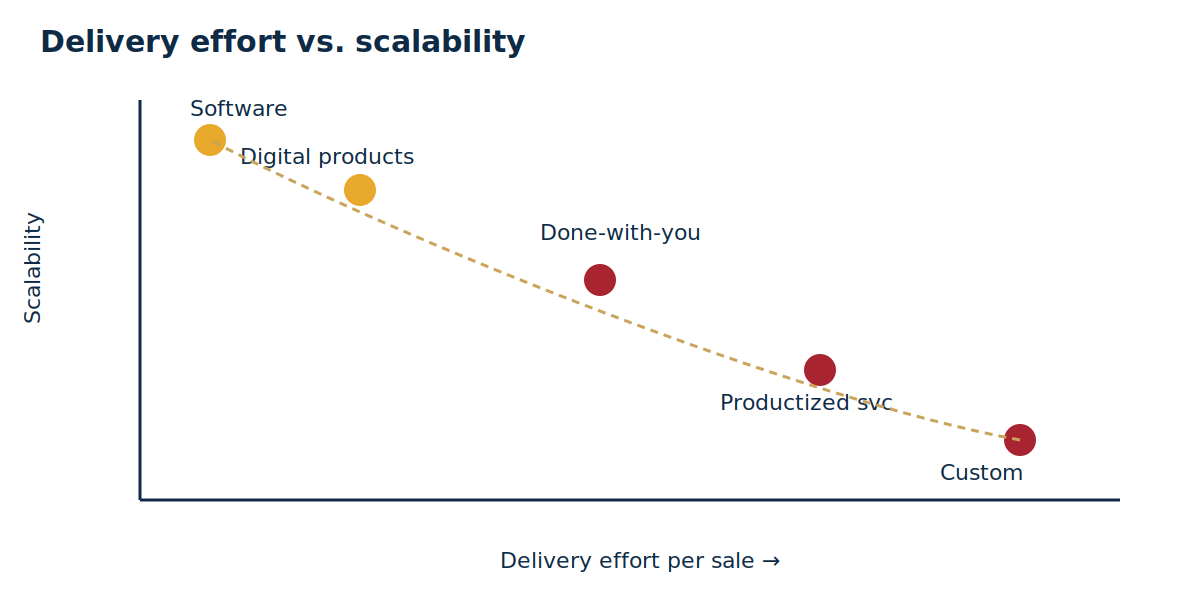
Productization isn’t binary; it’s a spectrum from fully custom service to fully scalable IP. Moving along it, you trade delivery effort for scalability:
- Custom service: Bespoke, one-to-one. Highest price per unit, zero scalability.
- Productized service: A defined scope, fixed price, repeatable process (e.g. “a brand audit” as a standard package). Still delivered by you, but systematized.
- Done-with-you programs: Group coaching or cohorts where your time serves many at once. Leveraged, not eliminated.
- Digital products: Courses, templates, playbooks, tools. Sold repeatedly with near-zero marginal delivery cost. True scalable IP.
- Software / SaaS: Your methodology encoded into a product that runs without you. The highest scalability — and the highest build cost.
What to Productize First
You don’t invent a product from nothing — you extract it from work you already do. The best candidates hide in plain sight:
- The advice you repeat. If you explain the same concept to every client, that’s a course or guide waiting to be built.
- The templates you reuse. The spreadsheets, frameworks, and documents you rebuild each engagement are products with the custom parts removed.
- Your signature methodology. The distinctive process behind your results — named, documented, and packaged — is your most defensible IP.
- The first step clients struggle with. A lower-priced product that solves the entry-level problem can become the on-ramp to your high-ticket services.
Your expertise is already a product. It’s just currently delivered in the most expensive, least scalable format possible — live, by you, one client at a time.
Productization as a Portfolio, Not a Pivot
A crucial nuance: productizing doesn’t mean abandoning high-ticket services. The smartest consultants run both. Digital products build audience, generate leads, and create passive revenue; high-ticket services monetize the trust those products create. A well-designed course can be the top of a funnel that ends in a six-figure consulting engagement. The IP and the service reinforce each other rather than compete.
How to Start Without Overbuilding
- Validate before you build. Pre-sell the product, or test the idea with a small paid pilot, before investing months in production. Demand first, build second.
- Start small and specific. A tightly-focused template or mini-course that solves one real problem beats an exhaustive “everything” course no one finishes.
- Reuse existing delivery. Record a workshop you’re already running. Package a framework you already use. The lowest-effort first product is the one that already exists in your service work.
- Price for the outcome, not the format. A template that saves a client weeks of work is priced on that value, not on “it’s just a spreadsheet.”
The Bottom Line
Turning active service into scalable IP is how consultants escape the time-for-money trap without abandoning what makes them valuable. Start by extracting one product from work you already do, validate it with real demand, and let it work alongside — not instead of — your premium services. Do this consistently, and you build a business whose value is no longer capped by the hours in your week.
Sources & Further Reading
- Eisha Armstrong, Productize — a practical framework for services-to-products transformation.
- Harvard Business Review on scaling professional services and knowledge assets (hbr.org).
- Consulting Success on productized services and recurring revenue (consultingsuccess.com).