
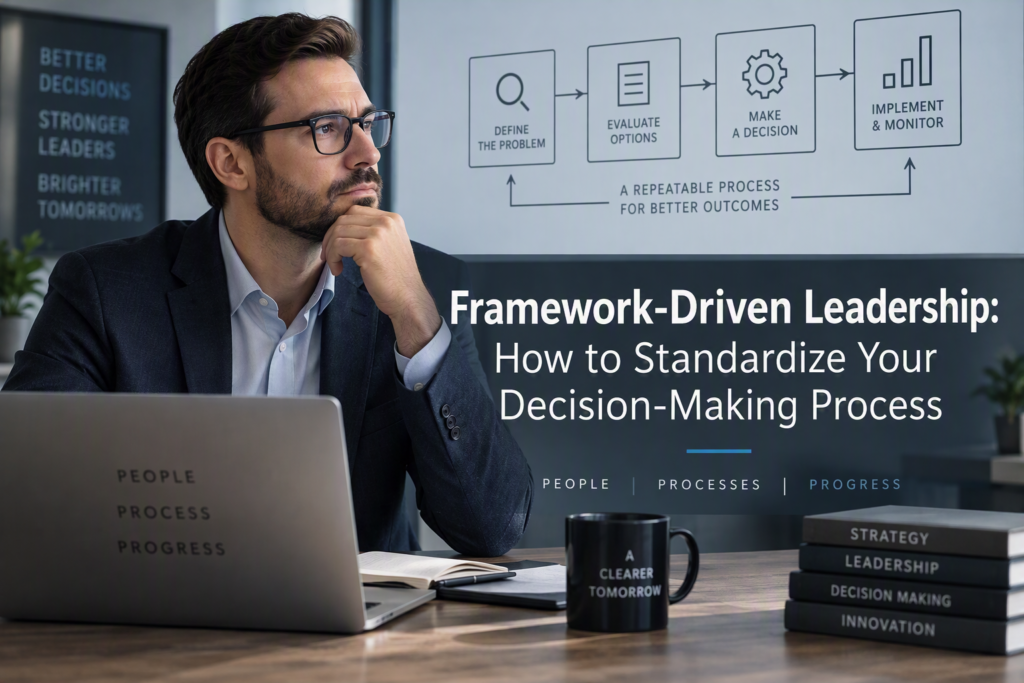
The best executives aren’t faster decision-makers because they’re smarter. They’re faster because they’ve stopped making every decision from scratch. They’ve replaced improvisation with frameworks — repeatable mental models that turn judgment into a system your whole organization can run.
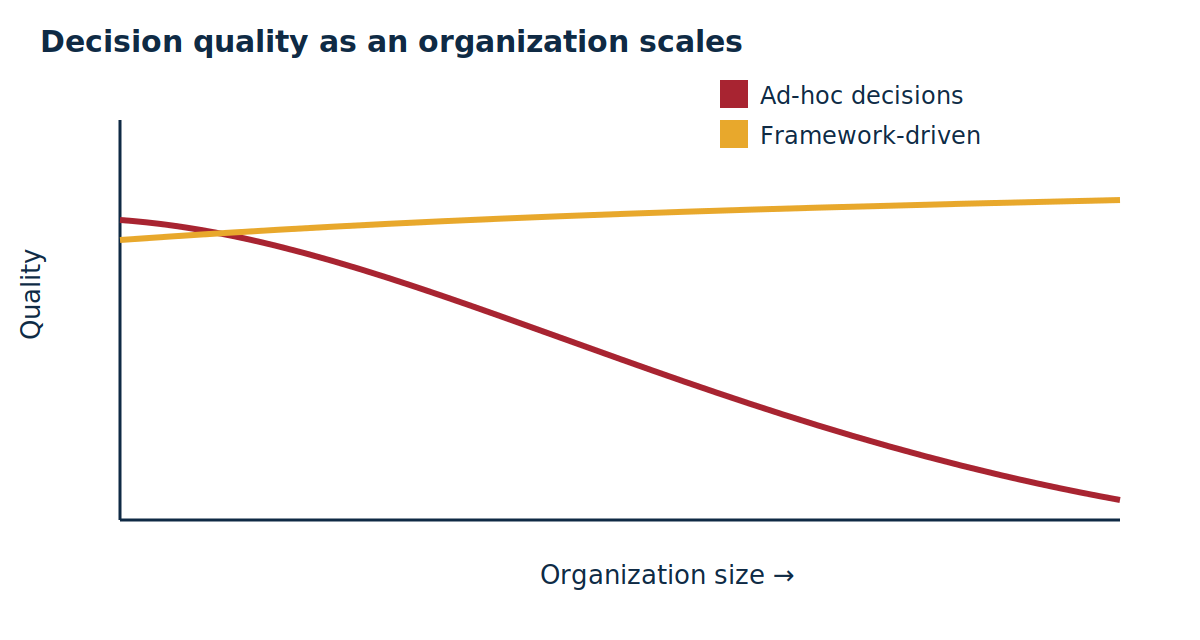
Why Ad-Hoc Decision-Making Doesn’t Scale
In the early days of any venture, the founder is the decision engine. Every pricing call, hire, and priority flows through one head. It works — until it doesn’t. As the organization grows, that centralized model becomes the bottleneck. Decisions queue up, context gets lost, and the leader burns cognitive fuel on questions that should never have reached their desk.
The research on this is sobering. Analyses of founder performance have found that sustained stress measurably degrades decision quality — with a large share of founders reporting that overload directly impairs the choices they make. When every decision is bespoke, volume alone eventually breaks the system.
What a Decision Framework Actually Is
A framework is a pre-committed structure for a recurring type of decision. Instead of asking “what should we do here?” from zero, you ask “what does our framework say about situations like this?” The judgment is done once, encoded, and then reused — by you and, crucially, by your team.
Consider a few battle-tested examples that executives adapt widely:
- The Eisenhower Matrix (urgent vs. important) for triaging where attention goes.
- Reversible vs. irreversible decisions — Amazon’s “one-way vs. two-way door” test — for calibrating how much deliberation a choice deserves.
- Second-order thinking — asking “and then what?” — to avoid solutions that create bigger problems downstream.
- Opportunity cost framing — every yes is a no to something else — for portfolio and time allocation.
Standardizing Without Becoming Rigid
The fear executives voice is that frameworks make an organization bureaucratic. The opposite is true when done well. Frameworks handle the recurring 80% of decisions so that human judgment is reserved for the genuinely novel 20%. They’re not a cage; they’re a filter that protects your scarcest resource — leadership attention — for the choices that actually need it.
The discipline is knowing which decisions to systematize. Reversible, high-frequency decisions are ideal candidates: encode them and push authority down. Irreversible, rare, high-stakes decisions stay with senior leadership and deserve slow, deliberate thought.
You don’t scale yourself by working more hours. You scale yourself by encoding your judgment so others can make the decisions you would have made.
How to Build Your First Framework
- Audit your repeat decisions. For one week, log every decision you make more than twice. These are your systematization candidates.
- Extract the principle. For each, write the rule you were actually applying, even implicitly. “We only take clients above X budget.” “We ship when it’s 80% ready, not 100%.”
- Document and delegate. Write the framework in plain language and hand the decision to your team, with the rule as their guide.
- Review the edges. When someone hits a case the framework doesn’t cover, that’s not a failure — it’s data to refine the rule.
The Compounding Return
Every framework you build pays a dividend forever. It removes a category of decision from your plate, speeds up your team, and makes outcomes more consistent. Over a few years, a founder who systematizes judgment ends up leading an organization that thinks the way they do — even in rooms they’re not in. That is what it means to scale leadership rather than just headcount.
Sources & Further Reading
- CEREVITY Tech Founder Burnout Survey (2025) — on stress and decision quality in founders.
- Shane Parrish, The Great Mental Models — accessible reference on reusable decision frameworks.
- Jeff Bezos, Amazon shareholder letters — origin of the “one-way vs. two-way door” decision test (aboutamazon.com).
- Harvard Business Review on decision-making under uncertainty (hbr.org).