
Key takeaway: most hackathon teams formed by strangers stop within weeks of the event. Based on available research, roughly 3–8% go on to incorporate a company and fewer than 1% are still operating as a viable business three years later. The main risk is rarely the technology. It is the team.
Hackathons are one of the fastest ways to go from idea to prototype. In 24 to 72 hours, people who have often never met form teams, build a product and pitch it to a jury. Some of those teams decide to keep going. But how often does a hackathon team of strangers actually become a sustainable startup?
This article reviews the available evidence on the hackathon startup success rate, offers a realistic percentage-based estimate and explains which soft skills make the difference between a weekend project and a company.
What the Research Says About Hackathon Projects
There is no large study that tracks only teams whose members were strangers before the event. The figures below therefore combine several related sources and should be read as indicators rather than exact measurements.
- Most hackathon projects stop after the event. Academic research on project continuation, including work by Nolte, Chounta and Herbsleb analysing thousands of projects listed on Devpost, found that only a minority of projects show any continued development after the event ends.
- Startup-focused events show higher short-term continuation. Startup Weekend organisers have reported that roughly a third of teams are still working together a few months after the event. That figure measures continuation, not commercial success.
- Startups in general face steep odds. U.S. Bureau of Labor Statistics data show that about one in five new businesses closes within its first year and roughly half within five years.
- Team problems are a leading cause of failure. Research by Noam Wasserman of Harvard Business School attributes a large share of high-potential startup failures to co-founder conflict, and CB Insights post-mortems consistently list “not the right team” among the top reasons startups fail.
A Realistic Estimate of the Odds
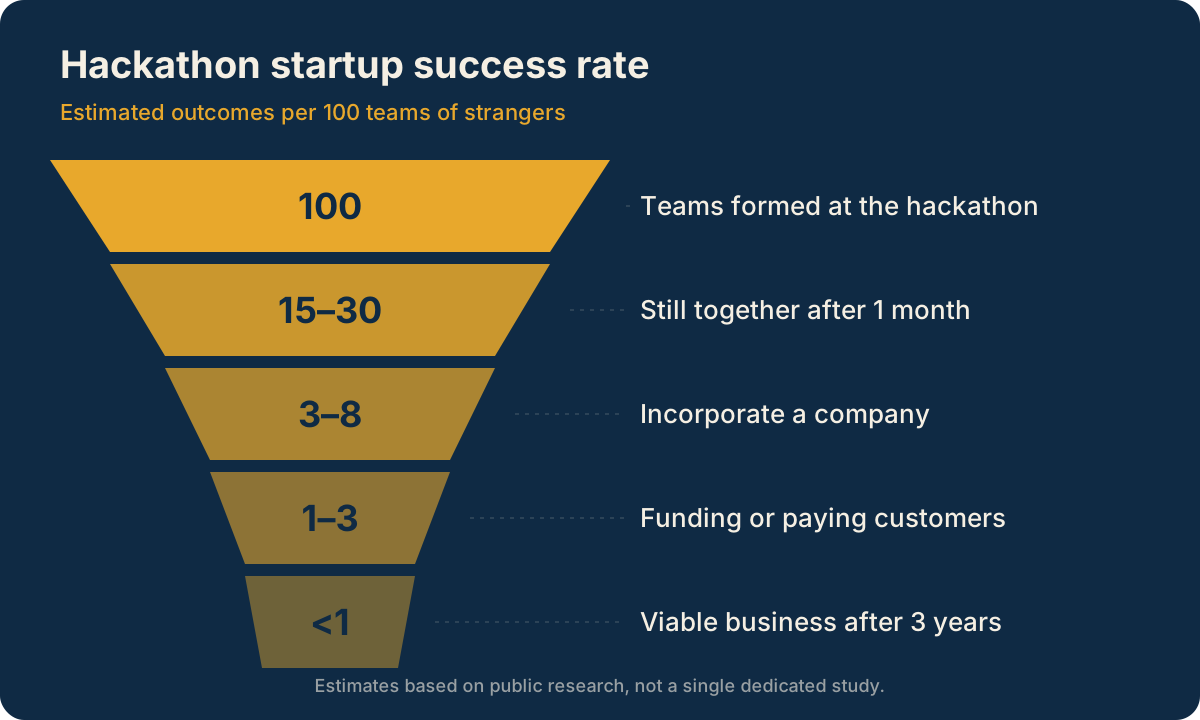
Combining these sources gives the following estimate for a hackathon team of strangers. These are informed approximations, not results from a single dedicated study.
| Milestone | Estimated share of stranger teams |
|---|---|
| Still working together one month after the event | 15–30% |
| Legally incorporate a company | 3–8% |
| Raise outside funding or reach paying customers | 1–3% |
| Still operating as a viable business after three years | below 1% |
Claims that 20–30% of hackathon startups “succeed” usually refer to short-term continuation, not to building a sustainable business. Defining success clearly is the first step to reading any statistic about hackathon startups correctly.
Why Teams of Strangers Face Extra Challenges
Hackathons reward speed and demo quality. Startups reward persistence, trust and alignment over years. Teams formed among strangers begin with specific disadvantages:
- No shared history of trust. Co-founders who have worked together before already know how each other handles pressure and disagreement.
- Unspoken differences in commitment. One member may see a career path while another sees a fun weekend.
- Unclear ownership and roles. Equity, intellectual property and decision rights are rarely discussed during the event.
- Event-driven ideas. Ideas shaped by a theme or a sponsor challenge are not always validated by real market demand.
There are also advantages: diverse skills, fresh perspectives and a proven ability to deliver under pressure. The teams that continue are usually the ones that address the disadvantages early.
The Soft Skills That Improve the Odds
1. Clear and Honest Communication
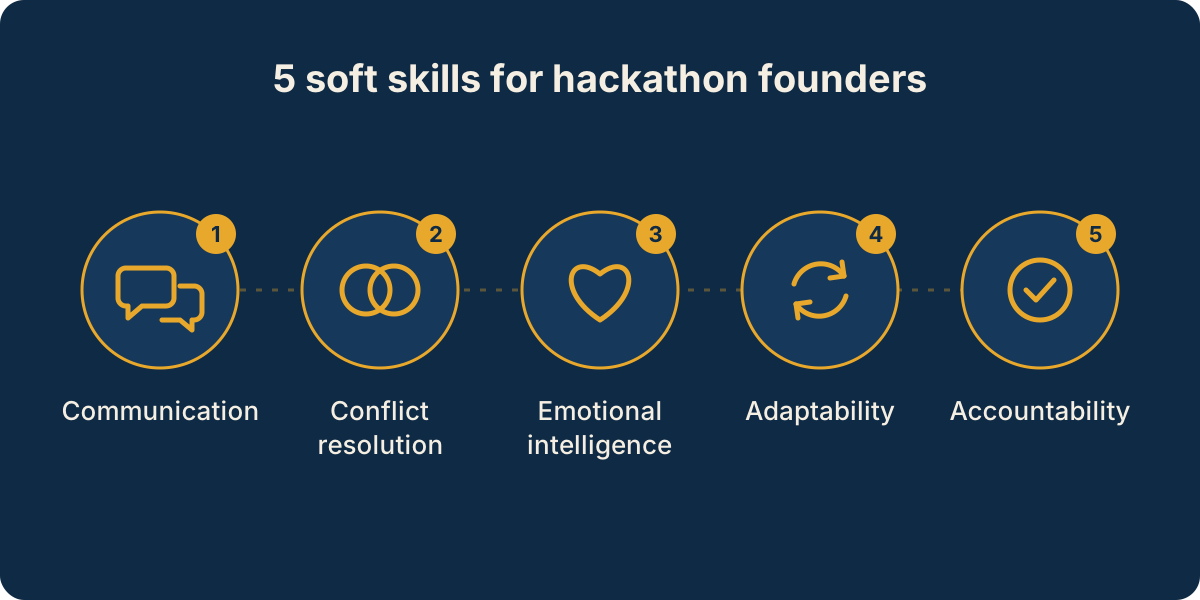
Discuss goals, available time and financial expectations within the first week after the event. Uncomfortable conversations held early prevent much larger conflicts later.
2. Conflict Resolution
Disagreement is normal in any founding team. Agree on how decisions will be made, and who has the final say in each area, before a real conflict arises.
3. Emotional Intelligence
Recognising stress, frustration and fatigue in yourself and your teammates helps maintain momentum once the adrenaline of the event fades.
4. Adaptability
The hackathon prototype is rarely the final product. Teams that listen to customers and are willing to pivot tend to last longer.
5. Reliability and Accountability
Trust between strangers is built through small promises kept. Weekly goals and short check-ins make commitment visible.
Practical Steps After the Hackathon
- Hold a structured debrief within 72 hours to decide, as a team, whether to continue.
- Run a 30-day trial period with defined goals before discussing company formation.
- Validate the idea with at least 10 to 20 potential customers.
- Put a simple written founders’ agreement in place covering roles, time commitment and intellectual property, and seek qualified legal advice before incorporation or equity decisions.
- Join an incubator or accelerator programme for mentorship and structure.
Frequently Asked Questions
What is the success rate of hackathon startups?
For teams of strangers, an estimated 3–8% incorporate a company and fewer than 1% are still a viable business after three years. Short-term continuation is higher, at around 15–30% one month after the event.
Can you find a co-founder at a hackathon?
Yes. A hackathon is a good way to see how someone works under pressure. Treat it as a first meeting, not a final decision, and use a trial period before committing.
Which soft skills matter most for a new startup team?
Honest communication and conflict resolution come first, because team conflict is one of the most common reasons early-stage startups fail.
Conclusion
A hackathon team of strangers can become a real startup, but the realistic odds are low: most teams stop within weeks, and only a small percentage build a lasting business. Founders and trainers who invest in communication, conflict resolution and accountability give their hackathon projects the best possible chance of lasting beyond the weekend.
Want to build these skills with your team or programme? Explore my entrepreneurship training sessions and coaching services.
The percentages in this article are estimates based on publicly available research and industry reports. They are provided for general information only and do not constitute legal, financial or investment advice.
Sources
- Nolte, A., Chounta, I.-A. and Herbsleb, J. D. (2020). “What Happens to All These Hackathon Projects?” Proceedings of the ACM on Human-Computer Interaction (CSCW).
- U.S. Bureau of Labor Statistics. Business Employment Dynamics: establishment age and survival data.
- Wasserman, N. (2012). The Founder’s Dilemmas. Princeton University Press.
- CB Insights. The Top Reasons Startups Fail.
- Techstars / Startup Weekend. Published programme outcome statistics.