
Winning an international business award feels like a finish line. It isn’t — it’s raw material. The trophy itself changes nothing; what you build around it does. Most winners collect the recognition, post once, and move on. The strategic operators turn a single award into years of credibility, access, and scale.
Why Awards Are Underrated Assets
In a crowded market, buyers and partners look for signals that reduce their risk. A credible, independent award is exactly that — third-party validation that someone with no incentive to flatter you judged your work as best-in-class. It short-circuits the trust-building that would otherwise take months of proof.
This matters most in high-stakes, high-ticket contexts. When a founder or executive is choosing between comparable providers, an international award functions as a tiebreaker and a justification — the safe, defensible choice. The recognition does work that no amount of self-promotion can replicate, precisely because it didn’t come from you.
The Leverage Framework: One Award, Many Assets
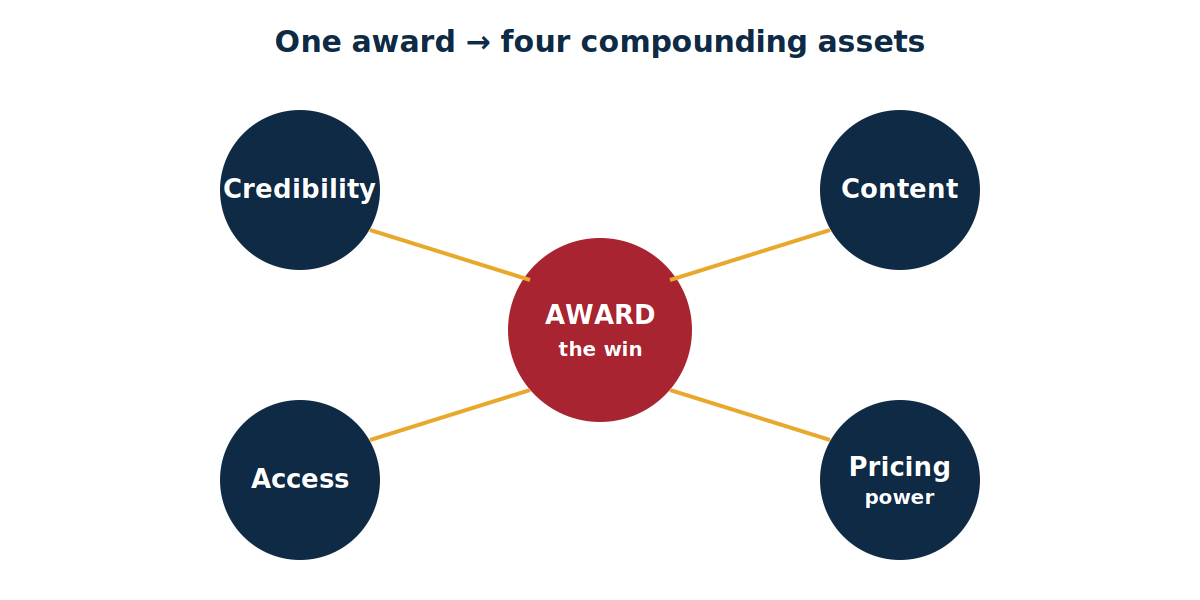
The strategic value comes from systematically converting one win into many uses across four dimensions:
- Credibility: Add it everywhere trust is decided — your site, proposals, email signature, speaker bios, and social profiles. “Award-winning” is a phrase that earns its place in a headline.
- Content: The award is a story engine. The problem you solved to win it, the judging criteria you met, the lessons behind the result — each is a piece of authoritative content that keeps the recognition working long after the ceremony.
- Access: Awards open doors to networks, alumni, judges, and fellow winners — often the highest-value relationships in your industry. The event itself is a room you couldn’t otherwise buy your way into.
- Pricing power: Recognized authority supports premium fees. An award is one of the assets that makes value-based pricing credible, because it substantiates the claim that you’re not interchangeable with a cheaper alternative.
Winning in the First Place
Leverage assumes you have something to leverage. A few principles raise your odds of winning credible awards:
- Target the right awards. Prestige and relevance beat quantity. One respected, independent international award outweighs a dozen pay-to-play badges that sophisticated buyers recognize as noise.
- Write to the criteria. Judges score against explicit rubrics. Map your application directly to each criterion instead of telling a generic story.
- Lead with quantified impact. “Reduced client costs by a measurable margin” beats “delivered excellent results.” Judges reward evidence.
- Tell a human story around the numbers. The data proves it; the narrative makes it memorable in a stack of applications.
An award is not proof that you’ve arrived. It’s a lever — and like any lever, its value depends entirely on how deliberately you apply force to it.
The Long Game
The founders who benefit most treat each award as the start of a campaign, not the end of an effort. They plan the content, the outreach, and the positioning before the result is even announced, so that the moment recognition lands, the machine to amplify it is already built. Recognition is perishable if you let it sit; compounding if you put it to work.
Your Next Step
If you’ve already won something — even a regional or niche award — audit where it currently appears. Most winners are shocked to find their recognition mentioned in one or two places. Systematically deploy it across all four dimensions above. If you haven’t yet applied for anything, identify two or three credible, relevant awards this quarter and write applications mapped tightly to their criteria. The recognition you earn becomes an asset you’ll compound for years.
Sources & Further Reading
- Harvard Business Review on third-party validation and buyer trust signals (hbr.org).
- Nielsen, research on the influence of independent endorsements and trust in decision-making (nielsen.com).
- Edelman Trust Barometer — annual data on the role of credibility signals (edelman.com).