
The solo-operator trap is seductive because it looks like dedication. You handle everything, nothing slips, and the business runs on your effort. Then one day the effort runs out — and you discover you didn’t build a company, you built a very demanding job that only you can do. The exit isn’t working harder. It’s systematizing delegation before burnout forces the issue.
The Data Every Founder Should See
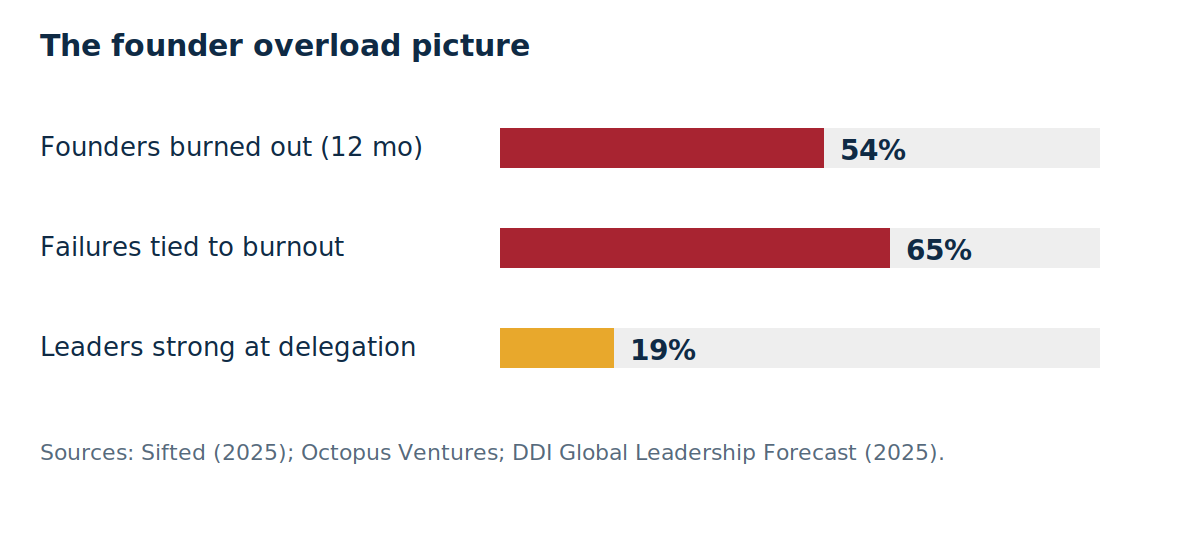
The scale of founder overload is not anecdotal. Recent research paints a stark picture: a Sifted survey found that 54% of founders experienced burnout in the past 12 months, and separate analyses report that a large majority of business owners work more than 40 hours a week, with a meaningful share exceeding 60. Octopus Ventures has attributed a striking 65% of startup failures to founder burnout or internal conflict rather than market conditions.
The through-line in this research is delegation — or the lack of it. DDI’s 2025 Global Leadership Forecast, drawing on assessments of tens of thousands of managers, identified delegation as the single most impactful burnout-prevention behavior, yet found that only about one in five rising leaders demonstrates strong delegation ability. The tool that prevents the collapse is precisely the one most founders never build.
Why Founders Don’t Delegate
The resistance is rarely about workload alone. It’s psychological:
- “No one can do it as well as I can.” Often true at first — and irrelevant. An 80%-as-good outcome that doesn’t require you is worth more than a 100% outcome that does.
- “It’s faster to just do it myself.” True for one instance, false across a hundred. The time to teach is an investment that pays back every subsequent time.
- “I’ll lose control.” You lose control by burning out, not by delegating with a system. Structured delegation increases control by making outcomes predictable without you.
The uncomfortable truth: for many founders, being indispensable is part of their identity. Letting go of tasks feels like letting go of self-worth. Recognizing that is the first real step.
Systematize Delegation Before You Need To
Delegation done in crisis fails — you dump tasks on unprepared people and conclude “delegation doesn’t work.” Delegation done as a system, before the crisis, compounds. Here’s the sequence:
- Document as you do. The next time you perform a repeatable task, record it — screen capture, checklist, or written steps. You’re building the operating manual in real time.
- Delegate the outcome, not just the task. Tell the person what “done well” looks like, not only the steps. This lets them handle variation without escalating everything to you.
- Start with the reversible. Hand off low-risk, high-frequency work first. Build trust and process before delegating anything irreversible.
- Create a decision framework. Give people the rules you use so they can decide without you (see the mental-models approach that lets teams act in your absence).
- Review outcomes, not activity. Check the results on a cadence, not the minute-by-minute work. Micromanagement recreates the bottleneck you were trying to remove.
If your business can’t run for two weeks without you, you don’t own a company — you are the company. Systems are how you convert one into the other.
The Payoff Is More Than Rest
Escaping the solo-operator trap isn’t only about avoiding burnout, though that alone is reason enough given the data. It’s about building something with enterprise value. A business dependent on one person is fragile and hard to sell; a business that runs on systems is resilient, scalable, and genuinely valuable. Delegation isn’t a concession to your limits — it’s the mechanism that turns your effort into an asset that outlasts your energy.
Start This Week
Pick the single most repetitive task currently on your plate. Document it once. Hand it to someone with a clear definition of “done well.” Resist the urge to take it back at the first imperfection. That one act, repeated, is how the trap opens.
Sources & Further Reading
- Sifted, Founder Mental Health Survey (2025) — burnout prevalence data.
- DDI, Global Leadership Forecast (2025) — delegation as a burnout-prevention behavior.
- Octopus Ventures — analysis linking startup failure to founder burnout and conflict.
- Gallup — research on CEO delegation and revenue growth (gallup.com).