

Updated 3 October 2026 to include Central Bank of Tunisia Circular No. 2026-10 and the BCT’s payments data for the first half of 2026.
Key takeaway: Tunisia’s payment infrastructure is already digital. The first half of 2026 saw a record 85.4 million electronic transactions worth 15.425 billion dinars. Its legal framework is not. Foreign exchange is still governed by a 1976 law, and the central bank’s new rulebook for payment institutions (Circular No. 2026-10, 25 September 2026) modernises governance and cybersecurity while keeping every domestic fintech locked inside the dinar and inside Tunisian territory. For a young Tunisian who sells code, design or courses abroad, getting paid legally costs roughly 10% to 20% of revenue, and the only friction-free alternative carries criminal exposure. The 2026 reform will be decided in its details.
Imagine being a young, talented Tunisian in 2026. You have a laptop, a fast internet connection and the skills to build an e-learning platform, write code for a client in Berlin or design a brand for a start-up in Montreal. You are not asking for a government job. You want to work hard, earn your living and bring foreign currency into your own country.
Instead of being treated as an exporter, you are treated as a suspect. Every payment from abroad is a file to justify. One mistake with a foreign account or a crypto wallet can turn into a case under the exchange-control law, with fines and prison sentences.
Freelancers in the United States, Europe and India receive international payments through Stripe or PayPal in a few clicks. Next door, Morocco gave its freelancers a simple legal status back in 2015, taxed at 1% of turnover for services. Tunisia, meanwhile, is still living inside a financial time capsule sealed in 1976.
The Anatomy of the Problem: A System Built on Suspicion
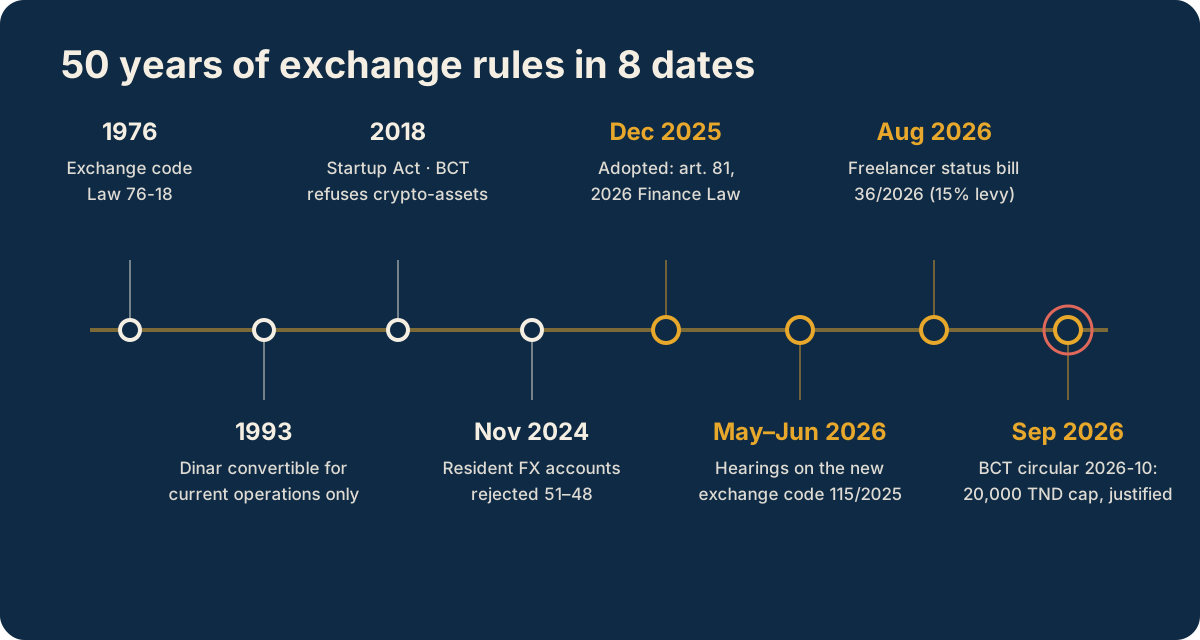
The current exchange code (Law No. 76-18 of 21 January 1976) was written for a world of import licences and paper letters of credit. Its architecture assumes that every flow of foreign currency is a risk to be contained, not a revenue to be captured. For freelancers and digital entrepreneurs, three structural roadblocks follow.
- The inconvertible dinar. The dinar is only convertible for current transactions, and the automated flow of foreign currency stays under tight central bank control. Stripe does not list Tunisia among its supported countries. A PayPal account opened in Tunisia can send money but cannot freely receive it. The world’s two most common ways of getting paid online are closed.
- The foreign company trap. To work around these limits, many Tunisians open a US LLC or a UK company. But Article 16 of the 1976 code requires residents to declare assets held abroad, and moving them without authorisation is an offence. Staying compliant means layers of bank fees, double currency conversion, foreign accounting and legal advice. The simulation later in this article puts that cost at 15.8% to 20% of revenue, before any risk premium.
- The crypto and USDT phobia. Since 2018 the central bank has refused to recognise crypto-assets, and dealing in them falls under exchange-control offences. Instead of regulating stablecoins and tracing clean digital money, the state chose a blanket ban. The activity did not disappear. It moved to informal peer-to-peer markets and cash hand-offs, where young people carry all of the risk.
The Bank Counter Nightmare
Even the “good students” who use the official route, a SWIFT transfer to a Tunisian bank, often discover a second obstacle course.
- Frozen transfers. A client abroad sends you $500 for a logo or a course. The money does not simply arrive. The bank’s compliance department puts it on hold until you prove what it is.
- The “justificatif” interrogation. You go to the branch, wait in line and defend yourself. You are asked for a stamped contract or a certified invoice for a micro-payment from a global platform that has never issued a paper document. If your file does not match the template, the money can be returned to the sender.
- Rules that change from one counter to the next. Each branch, sometimes each clerk, interprets the central bank’s rules differently. A transfer accepted on Monday can be blocked on Thursday. No business can be planned on zero predictability.
Circular No. 2026-10: Modernisation Inside a Locked Room
On 25 September 2026, the Central Bank of Tunisia published Circular No. 2026-10 on the rules governing payment institutions. It repeals and replaces Circular No. 2018-16 of 31 December 2018 and enters into force three months after publication. A corrected French version followed on 28 September; the BCT says it changes only the numbering of two articles, not their substance. Reading it as a ban on foreign clearing would be wrong. Reading it as a liberalisation would be equally wrong. It is best described as institutional containment with a modern interface.
What genuinely moves forward. The circular raises the ceiling of the highest-tier (“level 3”) payment account to 20,000 dinars and opens it to both individuals and companies. It creates a dedicated merchant account for electronic payment flows that is not subject to the tiered caps. It also gives payment institutions a clearer framework for electronic money, information security and personal-data protection. These are real improvements for the domestic market.
Where the gridlock lies. The same text states that payment services are provided “exclusively in Tunisian dinar and within Tunisian territory.” Funds arriving from abroad are limited to the equivalent of 20,000 dinars per operation and must be justified. A fintech licensed under this circular can therefore improve how Tunisians pay each other. It cannot become the bridge between a Tunisian creator and a foreign client.
The structural irony. While the perimeter stays domestic, the compliance load becomes close to banking-grade:
- an audit and risk committee attached to the board;
- independent control functions for audit, risk management and compliance;
- anti-money-laundering controls;
- an annual information-security audit by an independent firm certified by the National Cybersecurity Agency;
- monthly and quarterly reporting to the central bank.
Each requirement can be defended on its own. Taken together, they impose the cost structure of a commercial bank on start-ups that are allowed to operate only in a fraction of a bank’s market. The regulator has strengthened the governance of the pipe while keeping its outlet sealed.
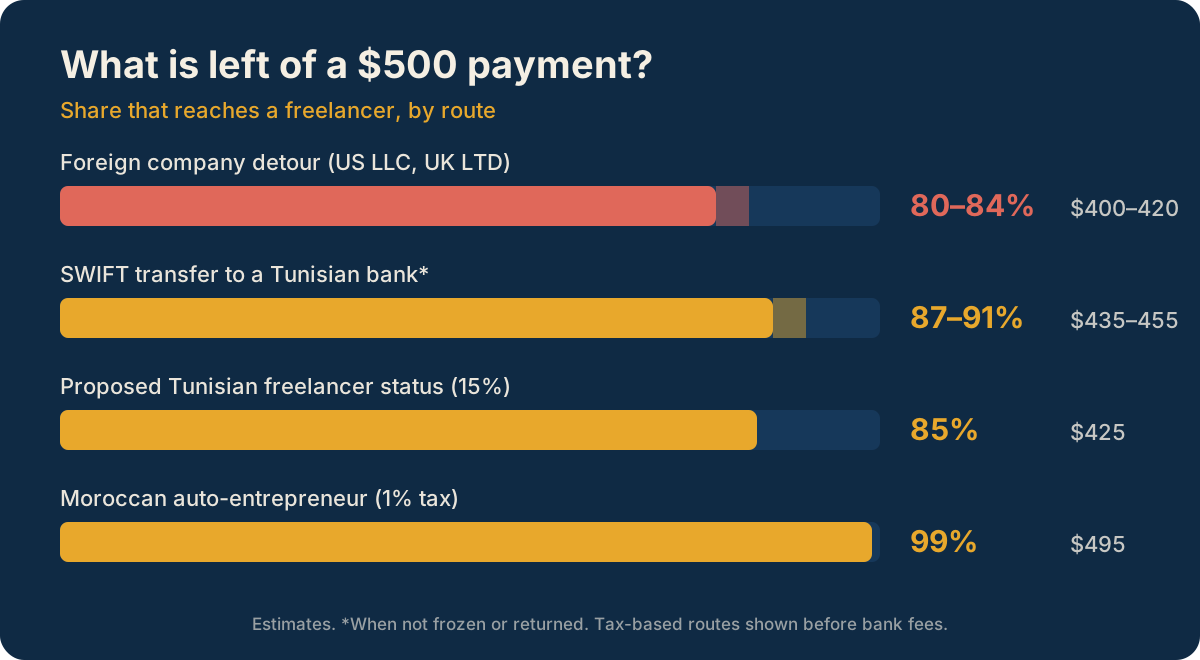
This chart makes an important point: a legal, transparent 15% contribution to the state would leave a freelancer with more money, and far more legal certainty, than the costs currently lost to detours and intermediaries.
The Multimillion-Dollar Math: What Tunisia Is Missing
This section separates two kinds of numbers that are often confused. Part A is measured data, published by the central bank. Part B is a predictive scenario, built on stated assumptions.
Part A — Measured: an ecosystem that is already digital (BCT, H1 2026)
| Indicator (first half of 2026) | Value | Year-on-year change |
|---|---|---|
| Electronic payment transactions (volume) | 85.4 million operations | +9.8% |
| Value of electronic transactions | 15.425 billion dinars | +11.2% |
| E-commerce payment transactions | 10.3 million (771.4 million dinars) | +22.1% in volume, +28.1% in value |
| Active mobile wallets | 218,886 | +5.5% (from 207,524) |
| Mobile wallet transactions | ≈5.12 million (914.2 million dinars) | — |
Source: Central Bank of Tunisia, “Paiements en chiffres”, 1st half 2026, Bulletin No. 17.
These figures settle one question: the constraint is not adoption. Tunisians already pay online, use cards and run mobile wallets at growing scale. Online payments are the fastest-growing segment, up 22.1% in volume in a single year. The infrastructure, the habits and the skills exist. What does not exist is a legal channel connecting that domestic system to foreign revenue. The ceiling is regulatory, not technological.
Part B — Modelled: what opening the channel could be worth (scenario, not forecast)
| Building block | Assumption | Annual flow |
|---|---|---|
| New formal digital exports | 50,000 freelancers × $800 per month | $480 million |
| Shadow crypto / USDT flows brought into the banking system | Formalisation of part of today’s informal market | $300 million |
| Direct annual injection | $780 million | |
| Total economic impact | Standard multiplier of 1.4 | $1.09 billion |
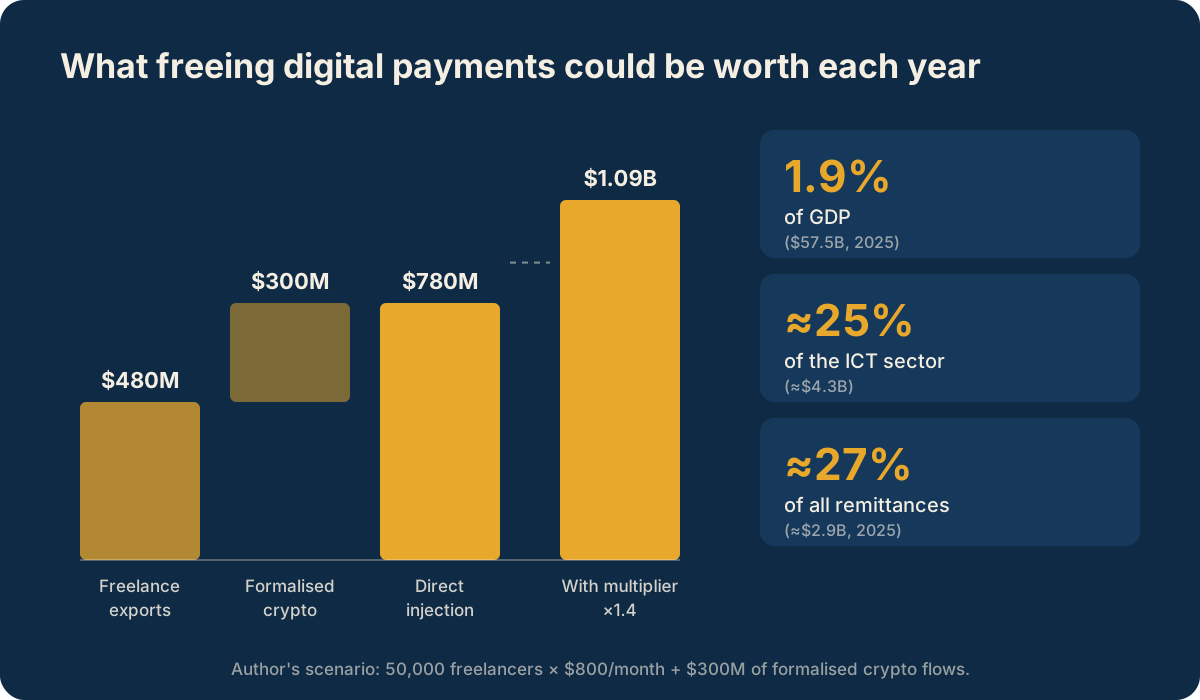
Scaled against official 2025 aggregates, the scenario implies:
- 1.9% of GDP. Tunisia’s GDP was about $57.5 billion in 2025 (World Bank). This is consistent with the 1 to 1.5 points of growth that the chair of parliament’s Finance Committee publicly associates with a new exchange code.
- About 25% of the ICT sector, which weighs roughly 7.5% of GDP, around $4.3 billion.
- About 27% of total remittances. Tunisians abroad sent 8.76 billion dinars home in 2025, around $2.9 billion. The direct $780 million would equal more than a quarter of that, earned by people who did not have to emigrate.
Emigration is the hidden variable. According to the Order of Engineers, 39,000 of its 90,000 registered engineers, 43%, have already left the country, and around 20 more leave every day. Every freelancer who cannot be paid at home is one more candidate for departure.
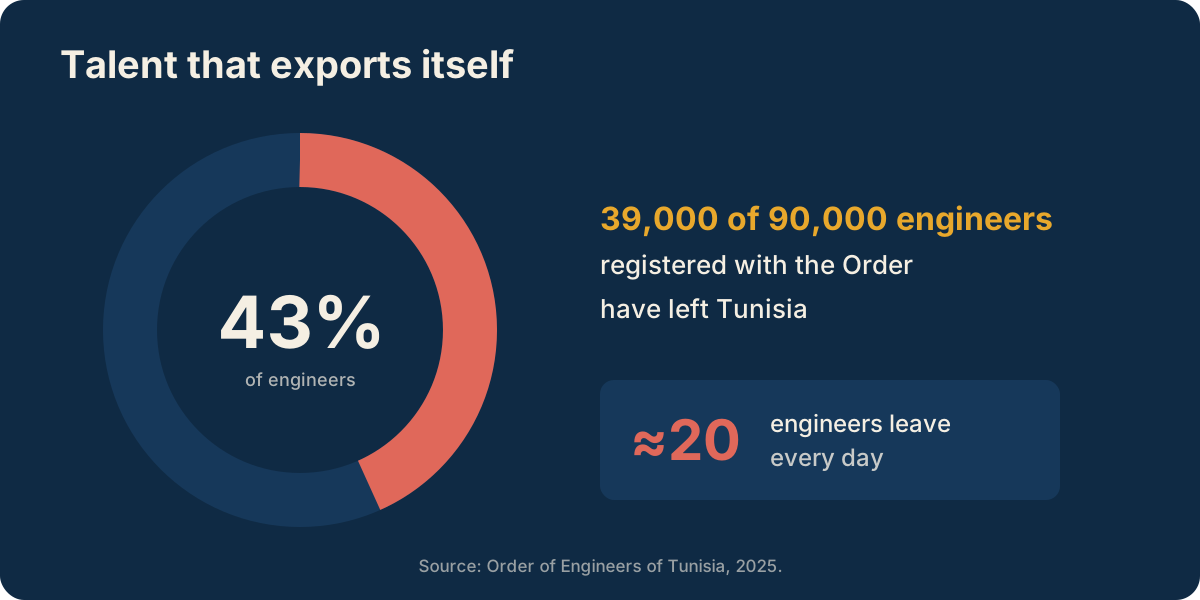
The macroeconomic channel is straightforward. Additional foreign-currency inflows would ease pressure on the central bank’s reserves, finance essential imports and reduce reliance on costly external borrowing. The money already exists. Today it flows around Tunisia rather than through it.
Where the Reform Stands in 2026
For the first time in decades, the legal framework is moving. That is precisely why the details now matter.
- Foreign currency accounts for residents. After a first rejection in November 2024 (51 votes to 48), parliament adopted in December 2025 the provision that became Article 81 of the 2026 Finance Law. Tunisian residents can now open foreign currency accounts without prior central bank authorisation. The operating conditions still depend on central bank implementing texts.
- A new exchange code. Bill No. 115/2025, 91 articles long, is meant to replace the 1976 law. It redefines residency, liberalises investment-related transfers, opens the door to accounts on international payment platforms and recognises crypto-assets. The Finance Committee held its hearings in May and June 2026, while the central bank had not yet presented its position.
- A freelancer status. Bill No. 36/2026 proposes to recognise freelancers officially, in exchange for a 15% levy on their income.
- A new payment-institution rulebook. Circular No. 2026-10 (above) modernises governance but keeps fintechs within a dinar-only, domestic-only perimeter.
The Blueprint: 4 Steps to Secure the Future
Tunisia does not need to reinvent the wheel. It needs to trust its youth and make sure that the texts on the table deliver in practice.
1. A real, digital freelancer status
Adopt a freelancer status that can be obtained online in a day, without creating a company. Let freelancers receive international transfers on a legal account without a stamped paper for every micro-payment: one declaration, one annual reconciliation. In exchange for the 15% levy, guarantee social security coverage and simple accounting.
2. A “digital export corridor” for payment institutions
Amend the perimeter of Circular No. 2026-10 so that licensed payment institutions and international gateways such as Stripe and PayPal can collect foreign-currency receipts for registered exporters. Funds would be converted or credited automatically, and the central bank would receive transaction data in real time instead of paper at the counter. The governance standards the circular already imposes are exactly what would make such a corridor safe.
3. Regulate stablecoins instead of criminalising them
Stop prosecuting young people for holding crypto. Follow international standards: licensed platforms, clear Know-Your-Customer (KYC) rules, reasonable taxation of gains, and peer-to-peer trade that happens in the open, where it can be traced and taxed.
4. Extend the Startup Act freedoms to every digital worker
The Startup Act (Law No. 2018-20) was a real first step: foreign currency accounts and an international technology card of up to 100,000 dinars a year. But it remains the privilege of a limited number of labelled start-ups, for a limited time. These freedoms should be open to every registered digital worker and creator, without the 8-year limit or the “scalability” filter.
Case Simulation: Amin’s Three Pathways
The following is a composite simulation built to make the legal and financial mechanics concrete. Amin is not a real person; the cost figures are illustrative modelling assumptions based on typical market fees, and the legal consequences are taken from the text of Law No. 76-18.
Amin is 26 and lives in Sfax. From a desk in a rented room near Bab Bhar, he runs an e-learning platform that sells short technical courses to students in Europe, the Gulf and North America. His average sale is $20. Over a year, roughly 2,500 of them add up to $50,000 in revenue, about 145,000 dinars. That is more than many mid-sized Tunisian exporters’ first-year turnover, earned entirely online. Getting that money home leaves him three doors. Each one has a price.
Pathway 1 — The domestic SUARL route: compliant, and stuck
Amin does everything by the book. He registers a single-shareholder limited company (SUARL), opens a business account and asks his international platforms to pay out by SWIFT.
The first payout, about $950 bundling 47 sales, is put on hold by the bank’s compliance desk. The officer asks for “the contract” behind the funds. Amin explains there is no contract: there are 47 students, each of whom clicked “buy” for $20. He is asked for invoices bearing a stamp and signature, matched to each incoming amount. He spends two days producing them. The next payout is accepted. The one after that is returned to the sender because a reference field did not match.
He turns to a domestic fintech, hoping for something more modern. Circular No. 2026-10 closes that door on paper as well. Payment institutions operate exclusively in dinars and within Tunisian territory, and funds from abroad are capped at the equivalent of 20,000 dinars per operation and must be justified. The fintech can help his Tunisian customers pay him. It cannot connect him to the 98% of his customers who are abroad.
The modelled cost:
- Fees on small payouts. Each SWIFT payout of around $950 costs about $40 in transfer and intermediary fees (≈4.2%), plus a 2% to 4% foreign-exchange spread. Small payouts make the fixed fee bite hardest.
- Bounced transfers. In the simulation, one rejected transfer per quarter means paying the fees twice and sometimes converting at a worse rate. That adds the final layer.
- Total: Amin loses an estimated 10% to 13% of his early revenue to the friction of getting paid.
- Time: more than any of the percentages, the friction eats his week. Paperwork, branch visits and uncertainty consume most of his operational focus. In his words: “80% of my energy goes into getting paid, 20% into the product.”
Pathway 2 — The offshore LLC plus local declaration route: legal, and leaking
Amin’s peers suggest the standard workaround: a US LLC with a Stripe account, plus a local tax registration (patente) to declare the income in Tunisia. To stay on the right side of the 1976 code, he must declare his foreign holdings (Article 16) and bring the earnings home through authorised channels. The model below assumes he does all of it.
| Cost item (annual, on $50,000 revenue) | Amount | Share |
|---|---|---|
| US registered agent, state fees and CPA filings | $900 | 1.8% |
| Card processing on $20 micro-sales (Stripe) | $2,250 | 4.5% |
| SWIFT transfers and double FX conversion (USD → bank → TND) | $1,230 | 2.5% |
| Local income tax and contributions provision (assumed) | $3,500 | 7.0% |
| Total leakage | $7,880 | 15.8% |
Add Tunisian accounting fees, legal advice on the declaration and the cost of the time spent, and the realistic range reaches 15.8% to 20%.
Two lines in that table carry the argument. The $3,500 is a contribution to the Tunisian state, and Amin would pay it willingly. The other $4,380, 8.8% of his revenue, is pure systemic leakage. It is paid to foreign intermediaries, correspondent banks and currency spreads, solely because the domestic system cannot receive the money directly. Multiplied across thousands of creators, it is a quiet export of value from a country that needs every dollar.
Pathway 3 — The shadow nomad route: frictionless, until it is not
The third door is the one many young Tunisians walk through quietly. Amin keeps the US LLC and its account, declares nothing and lives on ATM withdrawals from a foreign card, topped up when needed by selling USDT to peer-to-peer buyers who pay in cash. On a good month, the friction is near zero. That is exactly what makes this path attractive, and exactly what makes it dangerous.
Under Law No. 76-18, the exposure is no longer measured in percentages:
- Article 16: a resident’s undeclared account abroad is a breach of the declaration obligation.
- Article 35: exchange offences and attempted offences are punishable by one month to five years of imprisonment. The fine runs from 150 to 300,000 dinars and cannot be lower than five times the amount involved. On Amin’s $50,000, that is a floor of roughly $250,000 equivalent. For repeat offenders, the prison term can rise to ten years.
- Article 36: the court must order the confiscation of the funds involved. Where they cannot be seized, it imposes a payment equal to their value plus the illicit profit realised or intended.
The informal market adds risks that no statute lists: counterparties who disappear, fraudulent transfers, and a cash trail that can expose everyone involved. The irony is complete. The citizen bringing $50,000 a year of foreign demand into Tunisia carries the same legal exposure as a currency smuggler. Meanwhile, none of his money reaches the banking system, the tax base or the central bank’s reserves.
What the three doors reveal
| Pathway 1: Domestic SUARL | Pathway 2: LLC + declaration | Pathway 3: Shadow nomad | |
|---|---|---|---|
| Legal status | Fully legal | Legal if declared | Criminal exposure |
| Revenue lost to friction | ≈10–13% (early stage) | ≈15.8–20% | Near 0%, until enforcement |
| Predictability | Very low | Medium | None |
| Benefit to Tunisian reserves | Yes, slowly | Partial, delayed | None |
Each path either taxes compliance, leaks value abroad or criminalises success. A rational system would make the legal path the cheapest one. Tunisia’s makes it the most expensive. The reform currently before parliament can reverse that ranking. That is the whole case.
Conclusion: Let the Youth Work
Tunisian youth are not asking for handouts. They are asking the state to step aside and write rules they can follow. It is completely normal for the government and the central bank to take a fair share of income earned abroad. What is not normal is to treat a generation like criminals for the “offence” of being competitive on a global market.
There is a line I hear again and again from young people bent over their laptops in crowded cafés, from Tunis to Sfax:
« رانا ما حبّيناش نسرقو، حبّينا نخدمو برك »
“We never wanted to steal. We just wanted to work.”
It is time to rewrite the rules: free the currency, protect the creators and let Tunisia build its digital future at home.
If you are a freelancer or an early-stage founder trying to structure your activity in this environment, explore my entrepreneurship training and coaching services.
Methodology and disclaimer: Part A of “The Multimillion-Dollar Math” reports official BCT data. Part B and the case simulation are the author’s models, built on stated assumptions; they are not official forecasts or audited figures. Legal references are to Law No. 76-18 as published by the Central Bank of Tunisia. Nothing in this article is legal, tax or financial advice. Rules are changing in 2026, so check the latest texts and consult a qualified professional before making decisions.
Sources
- Law No. 76-18 of 21 January 1976 on the recasting and codification of foreign exchange and foreign trade legislation, notably Articles 16, 35 and 36. Text published by the BCT.
- Central Bank of Tunisia. Paiements en chiffres, 1st half 2026 — Bulletin No. 17.
- Challenges TN. Paiements en Tunisie : le mobile et l’e-commerce en forte hausse au S1 2026 (BCT).
- Managers (26 September 2026). Nouvelle circulaire de la BCT : voici ce qui change pour les établissements de paiement.
- Managers (28 September 2026). Circulaire sur les établissements de paiement : la BCT publie une version rectifiée.
- La Presse de Tunisie (27 September 2026). BCT : de nouvelles règles pour les établissements de paiement.
- webdo. Paiement mobile : la BCT durcit les règles et impose un audit cyber annuel.
- La Presse de Tunisie (4 June 2026). Réglementation de change : un nouveau code à l’examen.
- Tunisie Numérique (June 2026). Le Code des changes se rapproche de la séance plénière malgré l’absence de la Banque centrale.
- ilBoursa. Comptes en devises pour les résidents : ce que change la loi de finances 2026 (Article 81).
- Launch Base Africa (4 December 2025). Tunisia scraps 50-year forex rule to retain tech talent and startups.
- Le Courrier de l’Atlas (10 August 2026). Statut du freelance, PayPal, prélèvements : 5 choses à savoir sur la nouvelle proposition de loi (Bill No. 36/2026).
- Stripe. Global availability.
- World Bank. GDP (current US$) – Tunisia.
- African Manager. Tunisia: workers’ remittances reach 8.8 billion dinars in 2025.
- Smart Tunisia. Tunisian ICT sector estimated at about 7.5% of GDP.
- Entreprises Magazine (2025). La fuite des cerveaux s’accélère : 39 000 ingénieurs ont quitté la Tunisie.
- Startup Tunisia. Startup Act (Law No. 2018-20): benefits to start-ups.
- Kingdom of Morocco. Law No. 114-13 on the auto-entrepreneur status (2015).